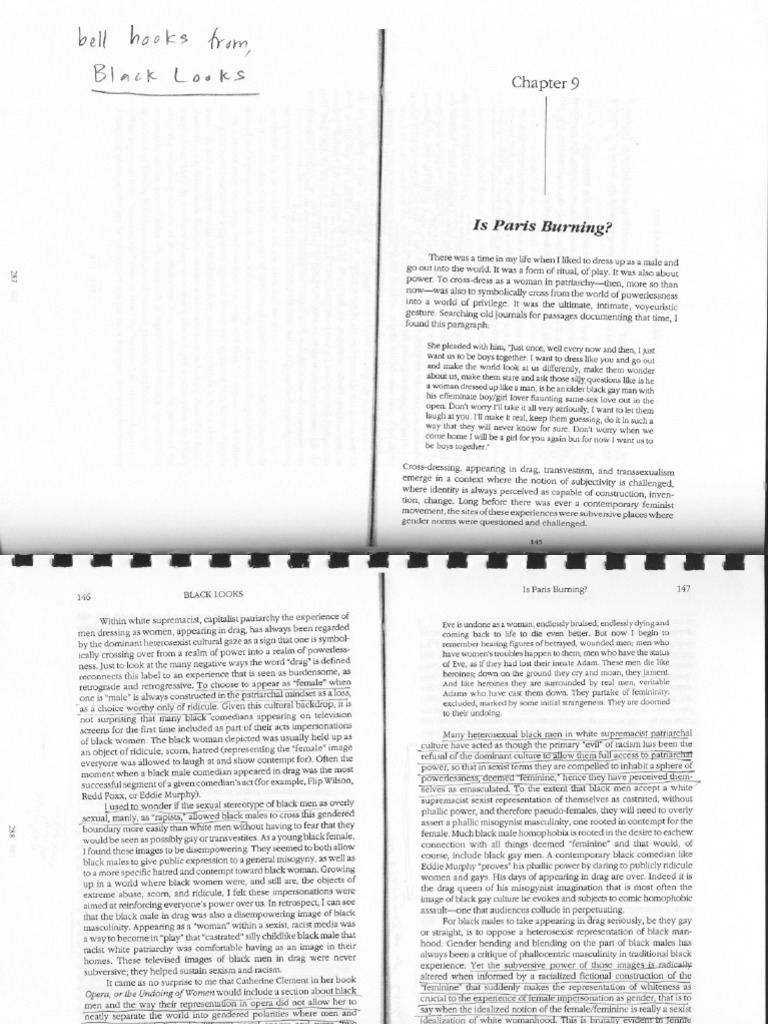
In the nuanced landscape of contemporary cultural commentary, few discourses resonate as profoundly as those surrounding identity, representation, and societal norms. Bell Hooks, an intellectual luminary, provides an incisive critique of drag culture as portrayed in the iconic documentary “Paris Is Burning.” This seminal work delves into the intricate dynamics of race, class, and sexual orientation, offering astute insights that transcend mere entertainment. Readers can expect an exploration of Hooks’ radical perspectives, an analysis of the implications of drag as a form of cultural expression, and an examination of how “Paris Is Burning” mirrors the complexities of identity in a capitalistic society.
At its core, “Paris Is Burning” is not merely a cinematic portrayal of drag queens and ball culture; it is a rich tapestry woven with threads of aspiration, resilience, and the relentless pursuit of self-identity amid the societal margins. Hooks examines this documentary through a critical lens, affirming that it serves as a microcosm of the broader struggles faced by marginalized communities. By foregrounding the narratives of those often overlooked, Hooks underscores how the art of drag becomes a platform for challenging conventional notions of gender and identity.
As Hooks explicates, drag is a powerful instrument of self-expression. It allows individuals to navigate and contest rigid binaries, enabling performers to explore multifaceted aspects of their identities. The flamboyance inherent in drag culture stands in stark contrast to the oppressive norms dictated by mainstream society. This inherent dichotomy serves as a site of both liberation and conflict, a theme that resonates deeply within Hooks’ analysis. For those participating in the ball culture, drag offers an exhilarating, albeit temporary, escape from the systemic constraints imposed upon them.
However, Hooks does not shy away from addressing the commodification of identity within this vibrant milieu. In her view, the very spectacle that captivates audiences can also perpetuate stereotypes and reinforce existing hierarchies. The transformation of drag into a consumable product raises critical questions about authenticity and representation. Is drag, in its commercialized form, diluting the radical potential it holds? Hooks challenges readers to confront these complexities, urging a reevaluation of how identity politics are navigated within the realms of art and performance.
Moreover, the intersectionality of race and gender plays a significant role in Hooks’ critique. In “Paris Is Burning,” the inherent disparities among performers — particularly regarding race and socioeconomic status — underscore the multifarious nature of identity. Hooks argues that while drag can be a site of empowerment, it is equally marred by the realities of systemic racism and classism. The film poignantly illustrates how participants carve out spaces for themselves in a world that often wishes to render them invisible, yet these spaces are fraught with challenges and contradictions.
Another compelling aspect of Hooks’ perspective is her recognition of the performative nature of identity itself. In a society that often demands conformity, the act of “performing” one’s identity becomes a means through which individuals articulate their existence. This performative aspect raises intriguing questions about the authenticity of self-expression. As drag queens navigate their performances, they are simultaneously engaging with notions of reality and illusion. Are they presenting their true selves, or are they crafting a persona tailored to societal expectations? Hooks deftly navigates this intricate web, imploring readers to consider the implications of such performances in their own lives.
Moreover, the documentary serves as a vivid illustration of the power dynamics inherent in the social fabric. The ball culture depicted in “Paris Is Burning” encompasses a rigorous hierarchy where participants compete for accolades and recognition. In this realm, the titles such as “house” signify not only camaraderie but also a battle for legitimacy and social currency. Hooks draws attention to how these competitions reflect broader societal structures, wherein visibility and validation are often linked to prevailing power relations. The yearning for recognition becomes a double-edged sword, one that propels performers into the spotlight while simultaneously reaffirming the parameters set by a consumer-driven culture.
In summary, Bell Hooks’ examination of “Paris Is Burning” provides a radical perspective that interrogates the complexities of drag and identity. Through her analytical lens, readers are invited to grapple with the nuanced interplay between empowerment and subjugation within drag culture. The documentary serves as both a celebration of resilience and a critique of the societal frameworks that shape identities. It compels audiences to reflect upon their own perceptions of identity, representation, and the multifaceted nature of existence. By embracing Hooks’ insights, one is equipped to engage with the radical potential of self-expression that transcends mere performance, fostering a deeper understanding of the transformative power that lies within both drag culture and artistic expression at large.