When we contemplate the myriad wonders of the natural world, we often uncover astonishing adaptations that speak to survival and evolution. Among these adaptations, the concept of vision stands out as particularly fascinating; it transcends mere perception and influences the very essence of existence for countless species. Imagine navigating the vastness of your environment, discerning hidden prey among foliage or detecting the faintest movements across a sprawling savannah. Such extraordinary capabilities not only illustrate the marvel of nature but also challenge our understanding of the limits of sight. In this exploration of animal eyesight, we delve into the intriguing question of which creatures possess the acme of visual prowess, leaving us marveling at their superlative sensibilities.
The diverse evolutionary paths taken by various species have birthed eyes that are masterpieces of adaptation. From the haunting abyss of the ocean floor to the vibrant canopy of the rainforest, vision plays an indispensable role in how animals interact with their environment. Several prime candidates emerge, each possessing unique ocular attributes that allow them to dominate their ecological niches.
1. The Peregrine Falcon
No discussion of superior eyesight is complete without acknowledging the peregrine falcon, a species renowned for its predatory finesse and remarkable angle of vision. With specially adapted eyes that can perceive a broader spectrum of color, this avian predator is capable of spotting prey from altitudes exceeding 3,000 feet. However, it is not merely distance that defines its prowess; the peregrine falcon can also distinguish between subtle shades and movements, an ability that becomes critical during high-speed dives where it can attain staggering speeds of over 240 miles per hour — making it the fastest animal on the planet. This ocular mastery is attributed to a special structure in its eyes known as the carotenoid-rich fovea, which enhances the clarity and detail of its vision.
2. The Mantis Shrimp
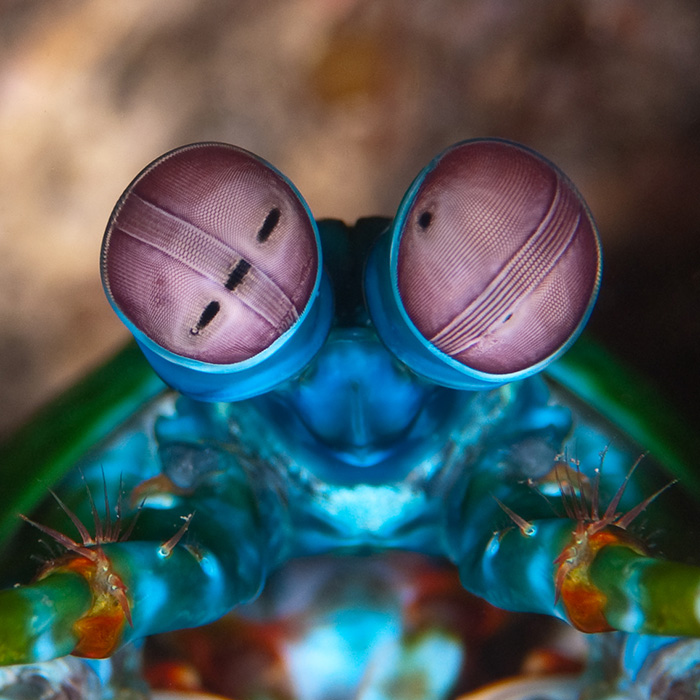
Crossing the threshold from the avian kingdom, we plunge into the dazzling depths of the ocean, where we encounter the mantis shrimp, a creature whose vision is truly otherworldly. Equipped with an astonishing 16 types of photoreceptors, as opposed to the mere three in human eyes, mantis shrimp can perceive ultraviolet light and polarized light. This extraordinary visual capacity allows them to decipher the intricate signals of their underwater realm and communicate with one another via vibrant colors and patterns that remain invisible to the human eye. In a world where many threats lurk in the shadows, the mantis shrimp’s visual acuity not only aids in hunting but also plays a paramount role in mate selection, contributing to their success in the aquatic ecosystem.
3. The Tarsier
Journey onward to the lush rainforests of Southeast Asia, where the tarsier reigns supreme among nocturnal creatures. Equipped with enormous eyes, surpassing the size of its head, this diminutive primate is an expert in low-light vision. The tarsier’s eyes are designed with a high density of rod cells, the photoreceptors that thrive in dim lighting, enabling it to detect movements and navigate its arboreal habitat during the twilight hours. What is particularly captivating is that due to their relatively fixed eye size, tarsiers must rotate their heads nearly 180 degrees to gain peripheral vision — resulting in a truly remarkable head-to-eye coordination that enhances their predatory efficiency.
4. The Horse
On land, one of the champions of visual acuity is the horse, whose wide-set eyes are strategically positioned for maximum field of vision. Facilitated by a nearly panoramic perspective that reaches near 360 degrees, horses can detect motion from great distances, a characteristic advantageous for spotting potential predators. Furthermore, their dichromatic vision allows them to discern between blue and green wavelengths, assisting them in foraging and navigating their environment effectively. The distinct evolutionary pressures faced on the plains have equipped horses not merely with superb eyesight but with a keen awareness of their surroundings, which is crucial for escape and survival.
5. The Gecko
Delving into the realm of reptiles, the gecko presents a compelling case for visual exceptionalism. With their acute night vision, these agile lizards have adapted to navigate and hunt in low-light conditions. Geckos possess a high concentration of rod cells, granting them unparalleled sensitivity to light, which allows them to thrive even under starlit skies. Additionally, their ability to see color in the ultraviolet spectrum gives geckos the upper hand when it comes to hunting insects or recognizing potential mates, rendering them gifted navigators of their nocturnal habitat.
6. The Owl
Finally, no discussion on remarkable eyesight would be complete without mentioning the owl, often dubbed the monarch of the night skies. These birds possess large, forward-facing eyes that are exquisitely adapted for nocturnal hunting. Owls have a higher ratio of rod cells to cone cells, enabling them to maximize their vision in darkness. Their unique ocular structure allows them to perceive depth with amazing accuracy, a trait that is critical when swooping down upon unsuspecting prey in the dim light. Moreover, owl species exhibit varied adaptations that further enhance their visual capability, such as the ability to rotate their heads nearly 270 degrees, allowing them to maintain a thorough visual field without moving their bodies.
In summary, the animal kingdom showcases a veritable cornucopia of visual adaptations, each tailored to the unique demands of its inhabitants. From the outstanding speed and precision of the peregrine falcon to the intricate color perception of the mantis shrimp, these examples illustrate that the quest for survival has engendered some of the most fantastical forms of eyesight. Nature’s ingenuity continues to unveil secrets that reinforce the complexity and interdependence of life, urging us to appreciate not just the beauty of the world around us, but the unseen adaptations that make survival an art of perception.